=”description” content=”Learn professional chemical odor control solutions for nail salons. Explore source capture systems and ventilation standards for nail salon owners.”>
Advanced Chemical Odor Control Solutions for Nail Salons
Managing chemical odors is a critical operational requirement for every professional nail salon owner.
Volatile Organic Compounds (VOCs) from nail monomers and cyanoacrylates require specialized management systems.
Proper air quality control ensures regulatory compliance and protects the long-term health of nail technicians.
The Importance of Source Capture in Nail Salons
Generic air purifiers are often insufficient for the high concentration of vapors found at a nail station.
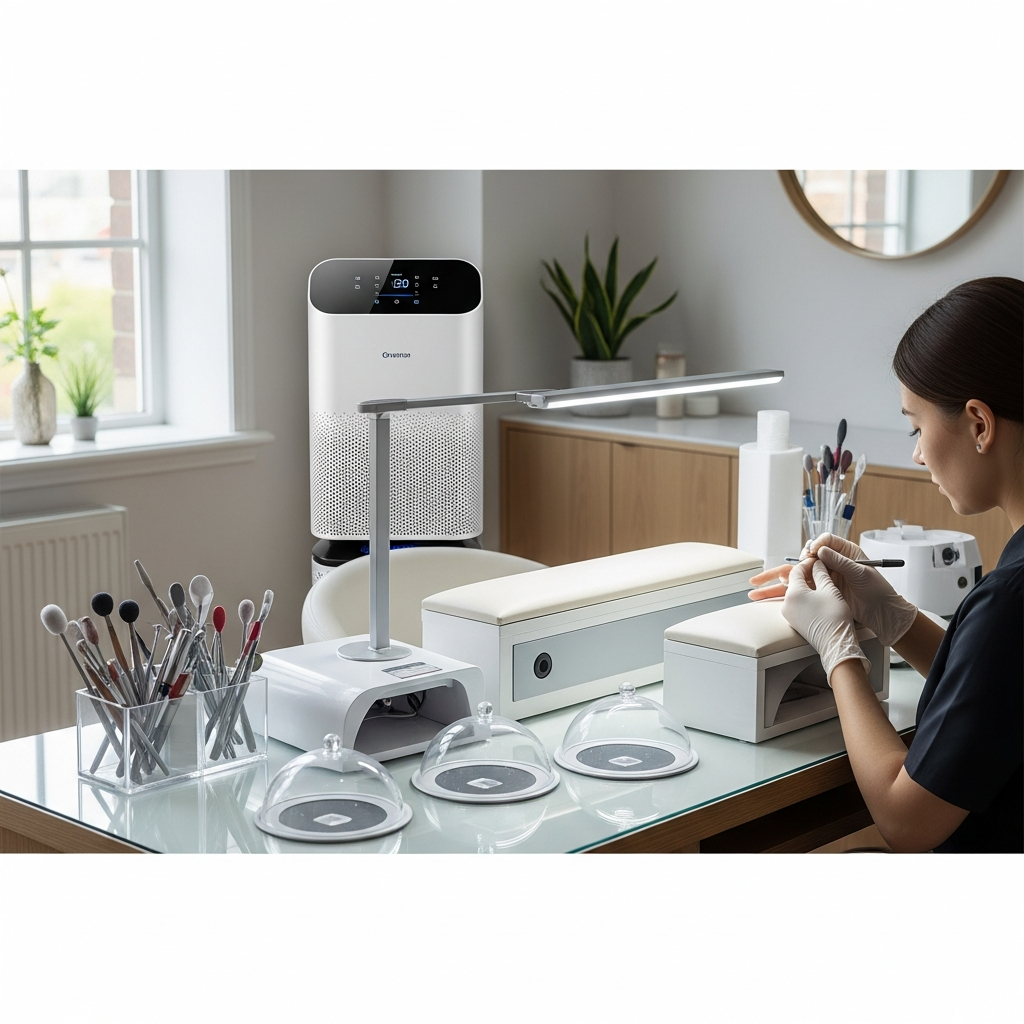
Source capture systems are designed to pull nail monomer vapors away from the breathing zone immediately.
These units must be positioned within three to six inches of the nail service area for maximum efficacy.
A professional source capture system utilizes high-grade activated carbon filters to neutralize chemical molecules.
Unlike standard HEPA filters that only trap dust, carbon filters specifically adsorb heavy nail chemical odors.
This prevents the lingering “acrylic smell” that can deter premium clientele and impact staff productivity.
Technical Requirements for Nail Ventilation Systems
- Minimum airflow velocity of 50 feet per minute at the capture point.
- Dedicated exhaust systems that vent nail chemical vapors directly outdoors.
- Multi-stage filtration including a pre-filter for nail dust and a deep-bed carbon filter.
- Regular maintenance schedules to ensure the carbon remains unsaturated and effective.
Distinguishing Between Nail Dust and Chemical Vapors
It is vital for nail salon owners to distinguish between particulate matter and gaseous chemicals.
Filing nail enhancements creates fine dust that can be managed with a standard desk vacuum or e-file attachment.
However, liquid monomer and gel systems release vapors that require chemical-specific filtration solutions.
Relying solely on dust collection for odor control is a common error in nail salon management.
True odor control involves a combination of local exhaust ventilation (LEV) and room-wide air exchange.
This dual-layered approach maintains a professional environment even during peak hours of acrylic application.
Operational Best Practices for Chemical Handling
Beyond mechanical systems, nail salon owners must implement strict chemical handling protocols to reduce odors.
Using small-opening dappen dishes minimizes the surface area of nail liquid exposed to the air.
This simple change significantly reduces the volume of vapor released during a full set application.
Proper disposal of chemically saturated materials is also essential for maintaining salon air quality.
Nail wipes and paper towels used for cleaning brushes should be placed in metal bins with self-closing lids.
Emptying these bins several times a day prevents the accumulation of odors within the nail salon facility.
Checklist for Improving Nail Salon Air Quality
- Install source capture systems at every professional nail workstation.
- Replace activated carbon filters every three to six months based on service volume.
- Verify that the HVAC system provides at least 20 cubic feet per minute of outdoor air per occupant.
- Switch to low-odor or HEMA-free nail systems where possible to reduce chemical load.
Evaluating ROI on Nail Salon Air Systems
Investing in high-quality chemical odor control is a strategic business decision for nail salon owners.
Reduced odor levels lead to higher client retention and lower staff turnover rates within the salon.
A clean-smelling nail salon projects a professional image and aligns with modern safety standards.
Furthermore, many insurance providers and local health departments now mandate specific ventilation for nail salons.
Implementing these systems early prevents costly retrofitting and potential fines during safety inspections.
Prioritizing air quality is a hallmark of a high-standard, professional nail industry establishment.
