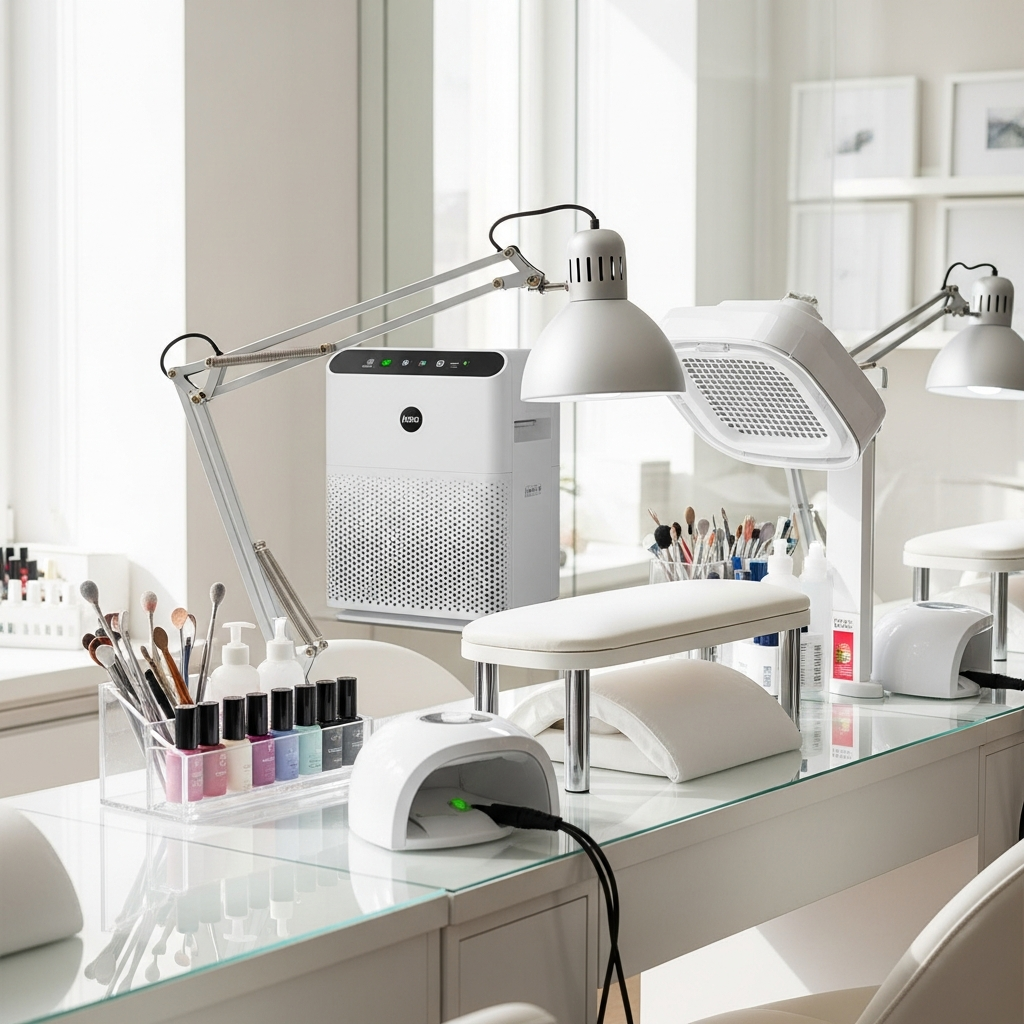
Implementing Professional Air Purification in Nail Salons
Managing indoor air quality is a critical operational responsibility for every professional nail salon owner.
Nail services generate microscopic dust particles and volatile organic compounds (VOCs) that require specialized filtration.
Effective air systems ensure a safe working environment while maintaining high professional standards for your clientele.
Understanding Nail Salon Specific Contaminants
Nail technicians are daily exposed to monomer vapors, cyanoacrylates, and various gel chemical odors.
High-speed e-file usage creates fine dust from acrylic and hard gel enhancements that remains airborne for hours.
Without professional extraction, these particulates settle on nail tools, workstations, and can be inhaled by salon staff.
Chemical Vapors and VOCs
Liquid monomer and nail adhesives release vapors that can cause respiratory irritation if not managed at the source.
Professional air systems use high-grade activated carbon to adsorb these chemical odors before they circulate.
Maintaining a scent-free environment is often a sign of a high-end, safety-conscious nail salon operation.
Source Capture Systems vs. Ambient Air Purifiers
Source capture systems are considered the gold standard for modern nail station safety and hygiene.
These units extract dust and chemical fumes directly at the technician’s breathing zone during nail services.
They prevent heavy acrylic odors from migrating throughout the salon floor and affecting other clients.
The Importance of HEPA and Carbon Filtration
HEPA filtration is necessary to trap 99.97% of fine nail dust, including debris from acrylic and polygel.
Activated carbon filters are specifically designed to neutralize the heavy molecular weight of nail chemicals.
Salon owners should prioritize dual-stage systems that combine both filtration types for maximum workstation protection.
Operational Benefits for Nail Salon Owners
- Staff Health: Reduced employee respiratory complaints and chemical sensitivity issues.
- Client Experience: Improved retention by providing a clean, odor-free nail service environment.
- Regulatory Compliance: Meeting local ventilation codes and professional nail industry safety standards.
- Facility Maintenance: Significantly lower cleaning costs by capturing nail dust before it settles.
Maintenance and Filter Replacement Workflows
Clogged filters drastically reduce the suction power of nail dust collectors and air purification units.
Salon managers must establish a strict schedule for replacing pre-filters and carbon canisters to maintain safety.
Professional maintenance ensures the longevity of expensive salon equipment and continuous air quality for the team.
Best Practices for Nail Station Setup
Position source capture intake hoses as close to the e-file or nail form as possible during the service.
Ensure that the exhaust from air units is not blocked by nail supply carts or pedicure chairs.
Consult with nail industry ventilation experts to ensure your salon’s cubic footage is properly covered by your system.
