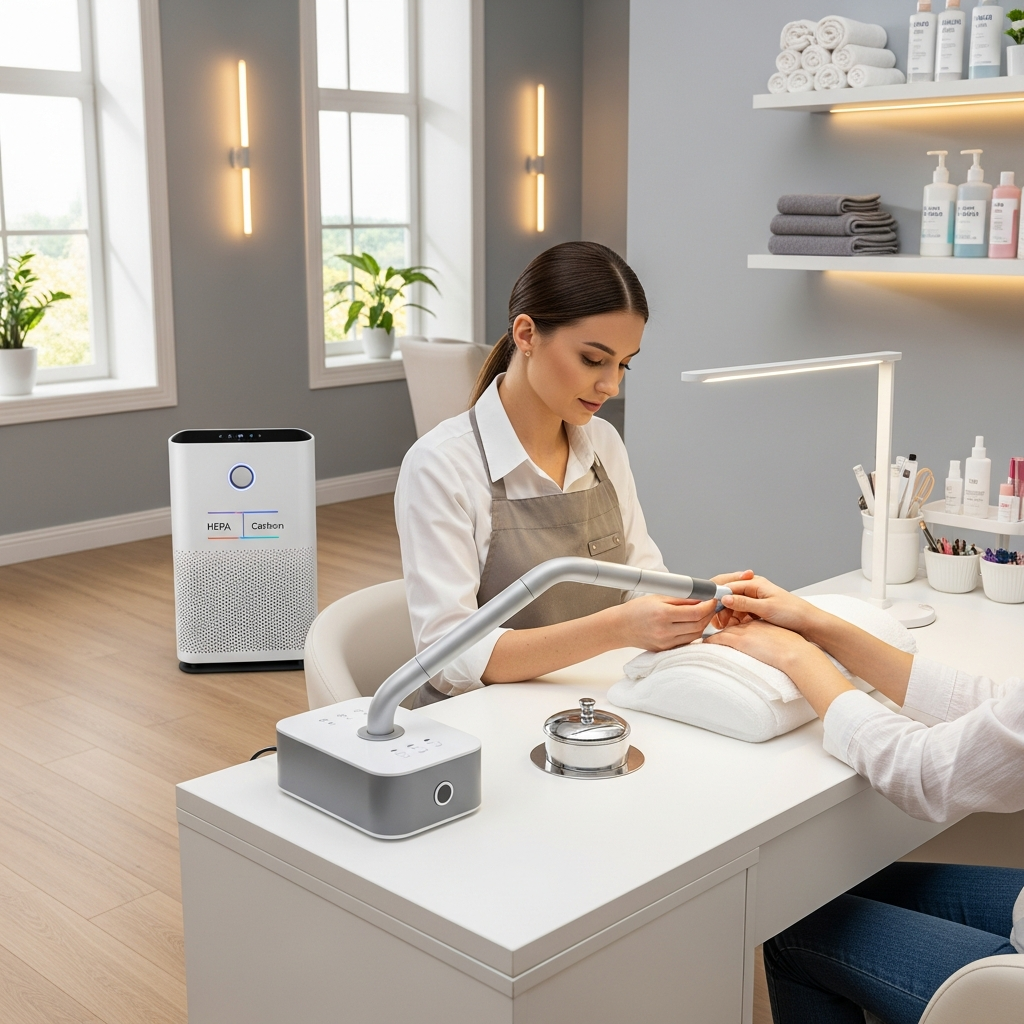
Professional Chemical Odor Control in Nail Salons
The Importance of Vapor Management for Salon Owners
Nail salon owners must prioritize the management of volatile organic compounds (VOCs). These chemicals originate primarily from liquid monomers, cyanoacrylate adhesives, and specialized primers.
Maintaining a low-odor environment is essential for long-term technician health. It also significantly improves the client experience during lengthier nail enhancement services.
Effective odor control requires a multi-layered approach to air quality. This involves source capture, room-wide purification, and strict chemical handling protocols.
Implementing Source Capture Systems at Nail Tables
Source capture systems are the most effective technical solution for local odor control. These specialized units sit directly at the nail technician’s workstation to extract vapors.
A professional source capture system utilizes high-grade activated carbon filters. These filters are specifically treated to trap monomer molecules before they disperse into the salon.
Proper placement of the extraction nozzle is critical for performance. It should be positioned within inches of the dappen dish to capture vapors at the point of origin.
Advanced Air Purification for Nail Chemical Residue
While odors are gaseous, nail dust can carry lingering chemical residues from polymers. Using HEPA filtration alongside carbon filters ensures a comprehensive air cleaning strategy.
Professional air purifiers for nail salons must be rated for chemical adsorption. Standard home-grade purifiers are often insufficient for the high VOC loads found in busy salons.
Regular maintenance of these systems is mandatory for operational safety. Salon managers should schedule filter replacements every three to six months based on service volume.
Professional Chemical Handling and Storage Protocols
Refining the technician workflow significantly reduces the chemical load in the air. Always use small-neck dappen dishes to limit the surface area of exposed liquid monomer.
Ensure all chemical containers, including monomers and acetone, are capped immediately after use. This practice prevents the continuous evaporation of solvents into the breathing zone.
Utilizing vapor-reduction dappen dish lids can further decrease odor levels. Small changes in daily habits lead to a measurable reduction in overall salon chemical scents.
Optimized Ventilation and HVAC Standards
A dedicated ventilation system must provide a specific number of air exchanges per hour. Salon owners should consult HVAC professionals to ensure compliance with local building codes.
Avoid recirculating air that has been contaminated with nail product vapors. Professional systems should ideally exhaust air to the outdoors to maintain the highest safety standards.
Supply air vents should be positioned to push clean air toward the technician. This creates a positive airflow that directs chemical vapors toward the exhaust or capture system.
Strategic Waste Disposal for Odor Reduction
Used table towels and wipes saturated with monomer are significant odor sources. These materials must be placed in a metal, lidded trash container immediately after a service.
Empty these waste containers multiple times throughout the day to prevent vapor buildup. This simple operational shift dramatically improves the ambient air quality for everyone.
Compliance with Safety Data Sheets (SDS)
Every nail salon owner must maintain accessible Safety Data Sheets for all chemical products. These documents provide specific instructions for managing spills and controlling odors.
Understanding the vapor density of your specific nail products is vital. This technical knowledge helps in positioning extraction tools and ventilation for maximum efficiency.
Investing in low-odor professional nail systems can also assist in odor management. Many modern EMA monomers are formulated to minimize the intensity of the chemical profile.
