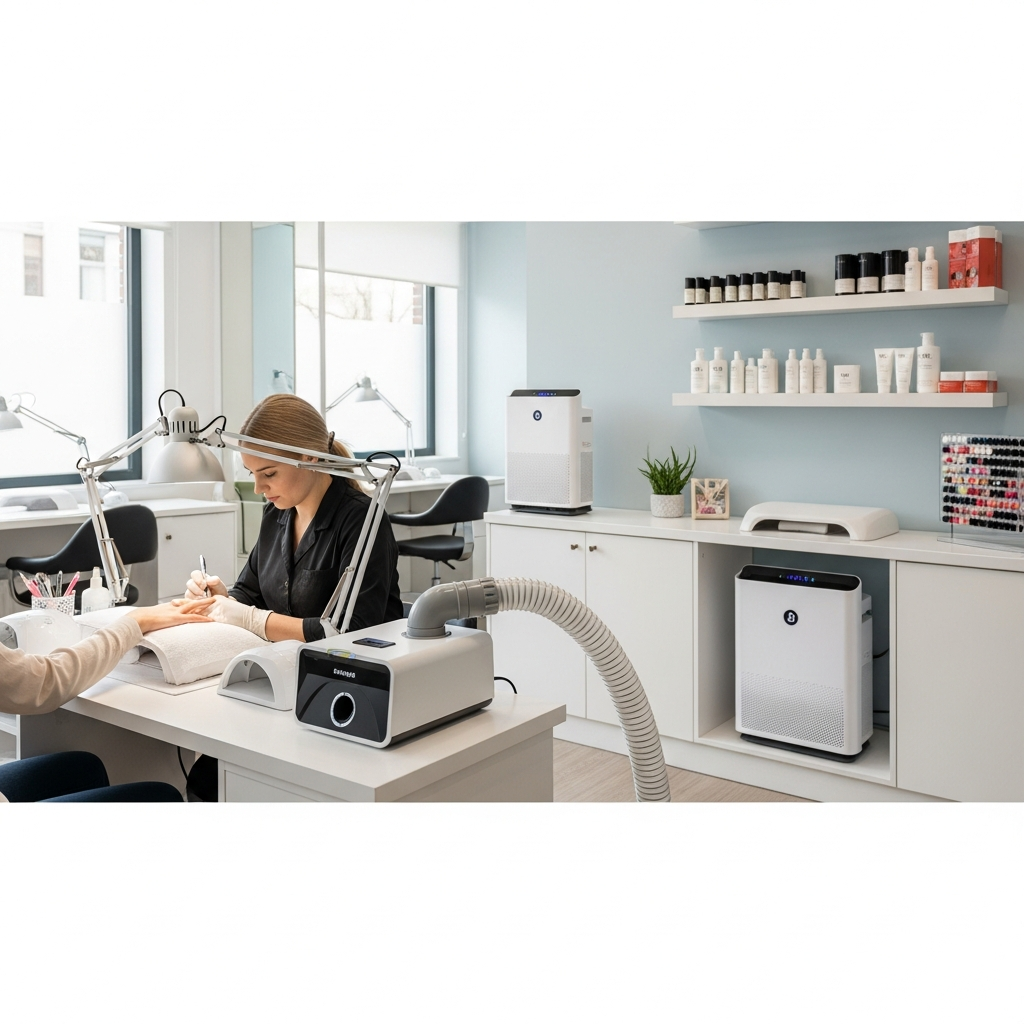
Selecting Professional Air Purification Systems for Your Nail Salon
Managing air quality is a critical operational requirement for modern nail salon owners.
Protecting technicians from inhalation of fine acrylic dust and chemical vapors ensures long-term health.
Effective air systems also improve the client experience by removing the distinctive “nail shop smell.”
Understanding Nail Salon Air Contaminants
Professional nail services generate two distinct types of airborne pollutants that require mitigation.
Filing gel or acrylic enhancements creates micro-particulates that can settle deep into the respiratory system.
Chemical services involving monomers and adhesives release Volatile Organic Compounds (VOCs) and heavy vapors.
General ventilation or standard HVAC systems are rarely sufficient for these specific industrial loads.
A dedicated air purification strategy must address both physical dust and chemical odors simultaneously.
This requires a combination of high-efficiency particulate air (HEPA) filters and activated carbon media.
Source Capture Systems vs. Ambient Air Purifiers
Source capture systems are designed to extract contaminants at the point of origin, such as the manicure desk.
These units use flexible hoses or built-in vents to pull dust and fumes away before they reach the technician’s breathing zone.
They are the most effective solution for high-volume acrylic and e-file heavy salons.
Ambient air purifiers treat the air in the entire room, cycling the volume several times per hour.
While effective for overall air freshness, they allow contaminants to travel through the room before being filtered.
Many salon owners find that combining source capture at the desk with ambient units provides the best coverage.
The Role of HEPA Filtration for Nail Dust
- Dust Collection: HEPA filters capture 99.97% of particles as small as 0.3 microns.
- E-file Protection: These filters are essential when using high-speed electric files on gel and acrylic.
- Maintenance: Filters must be vacuumed or replaced according to the manufacturer’s operational schedule.
Activated Carbon for Monomer and Adhesive Vapors
- Odor Control: Thick beds of activated carbon are required to adsorb liquid monomer (EMA) vapors.
- Chemical Weight: Ensure the unit contains several pounds of carbon rather than a thin, charcoal-coated fabric.
- VOC Removal: Carbon filters also neutralize vapors from nail primers, dehydrators, and tip adhesives.
Evaluation Criteria for Salon Owners
When comparing systems, salon owners must evaluate the Cubic Feet per Minute (CFM) rating of each unit.
A higher CFM indicates the unit can move more air, which is necessary for larger salon layouts.
Consider the noise level (decibels) to ensure the system does not disrupt the professional atmosphere.
Operating costs are another vital factor in the decision-making process for senior management.
Calculate the annual cost of replacement filters and the energy consumption of running units during business hours.
Investing in high-quality systems often reduces long-term maintenance costs and improves staff retention rates.
Integration into Salon Workflows
Positioning source capture units requires careful planning of the manicure station layout and power access.
Technicians should be trained to position the extraction hood within six inches of the filing area.
This ensures maximum capture efficiency during every service, from full sets to simple fills.
Establish a daily and weekly maintenance checklist for all air purification equipment in the salon.
Weekly inspections of pre-filters can prevent dust buildup from straining the motor and reducing airflow.
A clean filtration system signals a commitment to professional standards and safety for every client.
