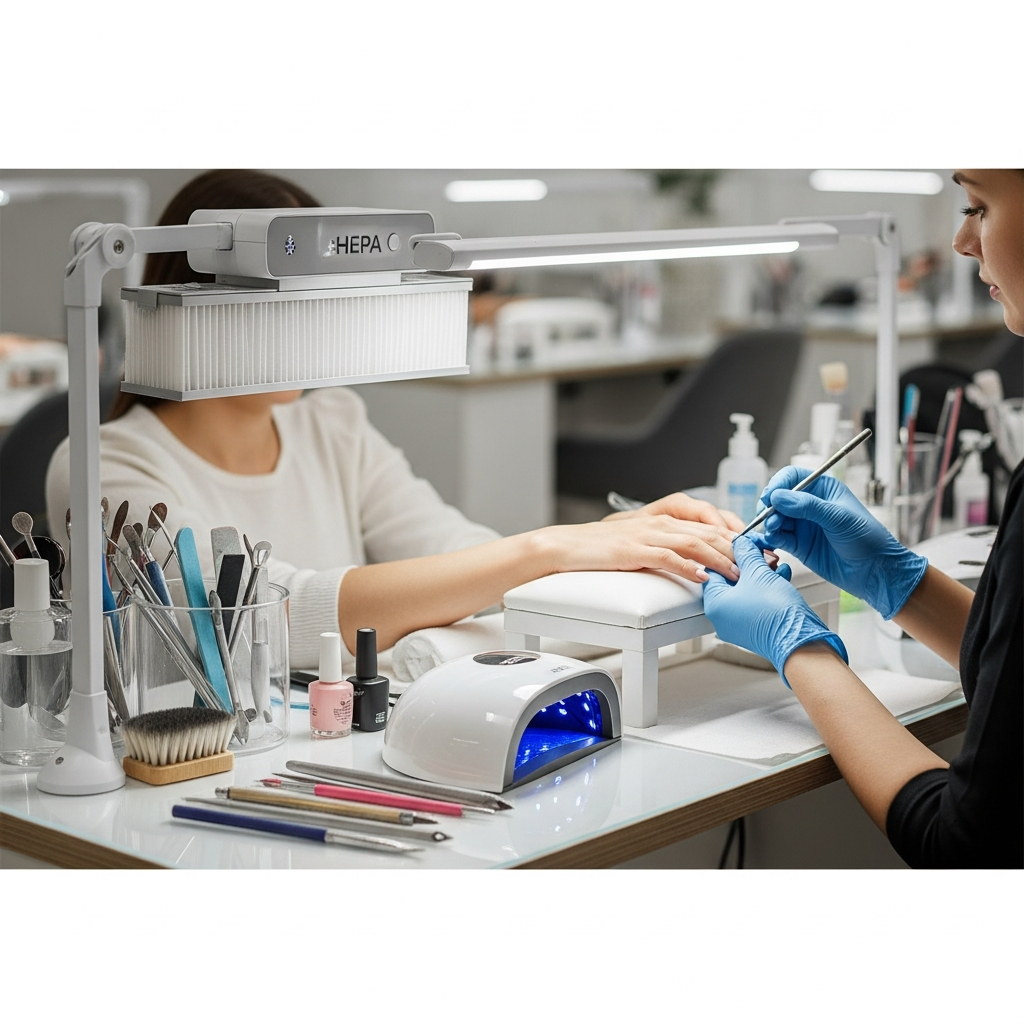
Implementing Professional Air Purification in Nail Salons
Maintaining high air quality is a fundamental requirement for modern nail salon operations.
The nail industry involves frequent exposure to fine particulates and chemical vapors.
Effective air purification systems are essential for protecting the health of technicians and clients.
Nail professionals work daily with products that release volatile organic compounds (VOCs).
These include monomers, cyanoacrylates, and various solvent-based polish systems.
Without proper ventilation, these vapors can accumulate and lead to long-term respiratory concerns.
Understanding Nail-Specific Air Pollutants
Nail salon air contains two primary types of contaminants: dust and chemical vapors.
Dust is generated during the filing of acrylics, hard gels, and dip powder enhancements.
Small particulates from e-filing can remain suspended in the air for several hours.
Chemical vapors, particularly from ethyl methacrylate (EMA), create the distinct “salon odor.”
While odor itself is not always an indicator of toxicity, high concentrations are problematic.
Professional-grade systems are designed to capture these specific molecules before they circulate.
Source Capture Ventilation vs. Room Air Purifiers
Source capture systems are the gold standard for nail salon safety and odor control.
These units utilize adjustable arms or vented manicuring tables to pull air directly from the work zone.
By capturing dust and fumes at the source, they prevent contaminants from entering the breathing zone.
Room air purifiers act as a secondary line of defense for the entire salon space.
They help cycle the air and remove lingering particles that escaped the source capture unit.
A combination of both systems ensures the cleanest possible environment for high-volume salons.
Key Features of High-Performance Nail Salon Filtration
Not all air purifiers are suitable for the unique demands of a professional nail environment.
Nail salons require specialized filtration media capable of handling both solids and gases.
Standard HEPA filters alone are insufficient for capturing chemical monomer vapors.
HEPA and Activated Carbon Standards
High-Efficiency Particulate Air (HEPA) filters are mandatory for capturing fine nail dust.
These filters trap 99.97% of particles as small as 0.3 microns, including acrylic dust.
This prevents the inhalation of microscopic debris during heavy filing or shaping sessions.
Activated carbon filters are necessary for the adsorption of chemical fumes and odors.
The carbon must be specially treated to neutralize the specific VOCs found in nail products.
Deep-bed carbon filters provide more surface area for chemical molecules to bind effectively.
Operational Benefits for Nail Salon Owners
Investing in advanced air purification improves the overall professional image of the salon.
Clients are increasingly aware of salon safety and prefer environments that lack heavy chemical odors.
A clean-smelling salon suggests a commitment to high standards and modern hygiene practices.
Furthermore, clean air reduces the accumulation of fine dust on salon furniture and retail displays.
This lowers the time spent on daily cleaning and protects sensitive equipment like e-files and UV lamps.
Maintaining a dust-free environment extends the lifespan of your professional tools and inventory.
Prioritizing air quality also supports technician retention and reduces health-related absences.
Nail technicians are the salon’s most valuable asset and deserve a safe workspace.
Proactive air management demonstrates a high level of professional responsibility and care.
Maintenance and Filter Replacement Schedules
For air purification systems to remain effective, regular maintenance is strictly required.
Pre-filters, which capture large dust particles, usually need cleaning or replacement weekly.
Clogged pre-filters restrict airflow and reduce the system’s ability to capture chemical vapors.
Main HEPA and carbon filters should be replaced according to the manufacturer’s hourly usage logs.
In high-volume salons, this may occur every six to twelve months to maintain peak performance.
Keeping a detailed maintenance log ensures your salon remains compliant with safety recommendations.
