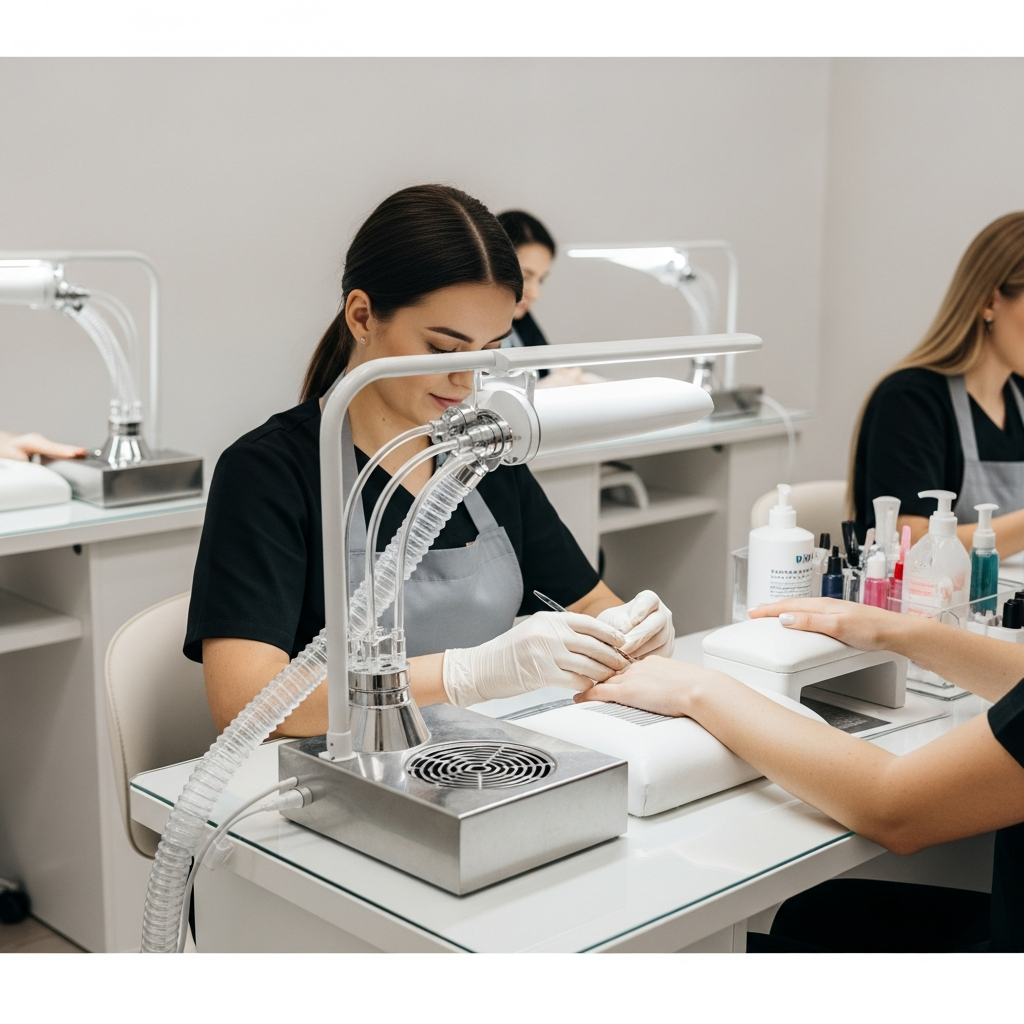
Implementing Source Capture Ventilation in Professional Nail Salons
The nail industry faces unique challenges regarding air quality and chemical exposure.
Nail salon owners must prioritize effective source capture systems to protect staff and clients.
These systems extract dust and vapors directly at the nail table during active services.
Protecting Technicians from E-file Dust and Monomer Vapors
Fine particulate matter from e-filing gel or acrylic can remain suspended in the air for hours.
Inhaling these particles leads to long-term respiratory issues for nail professionals.
Source capture units utilize high-suction motors to pull this dust away from the breathing zone.
EMA monomer vapors are heavier than air and tend to linger on the nail table surface.
Without localized ventilation, these chemical odors permeate the entire salon environment.
Activated carbon filters are essential for neutralizing these specific chemical molecules effectively.
Comparing Portable Extraction Units and Integrated Vented Tables
Salon owners must choose between portable desk units and integrated ventilation systems.
Portable extractors offer flexibility for changing salon layouts and lower initial costs.
They are ideal for independent booth renters or salons with limited floor space.
Integrated vented tables provide a professional aesthetic and more powerful airflow.
These systems are often connected to the building’s external exhaust or a centralized motor.
They require a higher initial investment but offer superior long-term air purification for high-volume shops.
Key Features to Evaluate in Nail Ventilation Systems
- CFM Ratings: Ensure the unit moves enough air to meet safety standards.
- Multi-Stage Filtration: Systems should include a pre-filter, HEPA, and carbon.
- Noise Levels: Choose motors that allow for comfortable client consultation.
- Adjustable Arms: Flexible hoods allow for precise positioning over the nail plate.
Compliance with IMC and Local Nail Salon Regulations
Many jurisdictions now enforce the International Mechanical Code (IMC) for nail salons.
Section 502.20 of the IMC requires specific exhaust rates at each individual nail station.
Owners must ensure their ventilation systems meet these minimum cubic feet per minute requirements.
Failure to comply can lead to failed inspections, heavy fines, or salon closures.
Investing in certified source capture equipment ensures the business remains legally compliant.
It also demonstrates a commitment to the health and safety of the nail professional community.
Operational Maintenance for Maximum Filter Efficiency
Regular maintenance is critical for the performance of any nail salon air system.
Pre-filters should be cleaned or replaced weekly to prevent acrylic dust buildup.
This practice prevents the motor from overheating and maintains strong suction at the hood.
Carbon filters require replacement every three to six months depending on salon volume.
Saturated filters lose their ability to adsorb monomer vapors and cyanoacrylate fumes.
Keep a strict maintenance log to track filter life and ensure a clean working environment.
Monthly Maintenance Checklist for Salon Managers
- Inspect flexible ducting for any tears or air leaks.
- Wipe down intake grilles to remove sticky gel or polish residue.
- Verify that the external exhaust vent is clear of obstructions.
- Test suction levels with a digital anemometer to confirm performance.
The Impact of Clean Air on Salon Branding and Retention
A salon that smells of heavy chemicals can deter high-end clientele and top-tier talent.
Implementing source capture systems creates a more pleasant, professional atmosphere.
This investment often leads to higher technician retention and increased client loyalty.
Modern nail salon owners view air purification as a core operational standard.
It is no longer a luxury but a necessity for sustainable nail industry operations.
Clean air is a hallmark of a high-performance, safety-conscious nail salon business.
