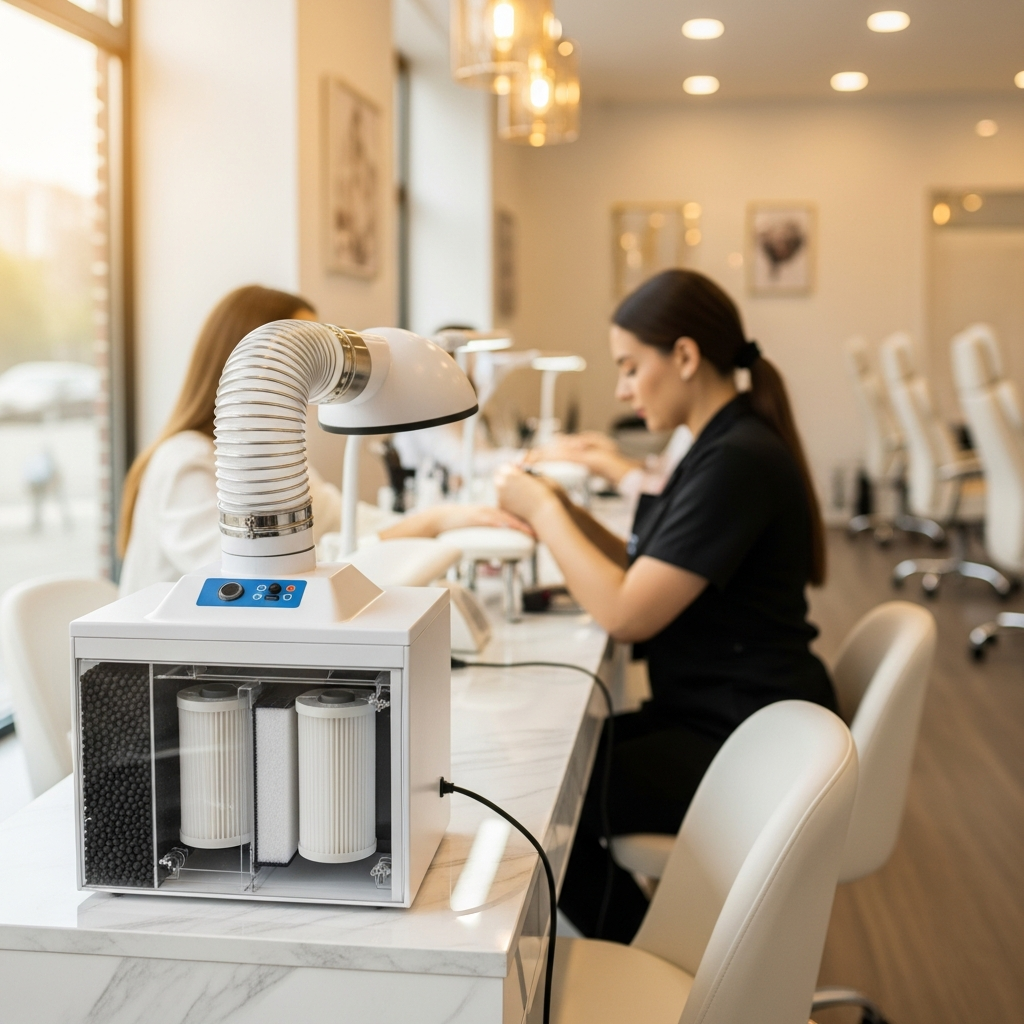
Professional Odor Control Solutions for Nail Salons
Managing chemical odors is a critical operational requirement for every professional nail salon owner. Monomer vapors and volatile organic compounds (VOCs) can impact the health of nail technicians and the comfort of your clients.
Effective odor control requires specialized equipment designed specifically for nail industry chemicals. General air purifiers often fail to capture the heavy molecules found in professional acrylic systems and gel enhancement products.
This guide evaluates the most effective chemical filtration systems available for nail salons. We focus on source capture technology and high-capacity carbon filtration to ensure a clean, professional environment for your staff and guests.
Evaluating Source Capture vs. Room Air Filtration
Source capture systems are the gold standard for nail salon safety and odor management. These units feature flexible ducts that sit directly at the nail table to extract fumes before they enter the breathing zone.
Room-wide air filtration systems act as a secondary defense by cycling the entire volume of air in the salon. For high-volume acrylic salons, a combination of both systems provides the most comprehensive protection against chemical exposure.
When comparing systems, salon owners must look at the Cubic Feet per Minute (CFM) rating and the specific filter composition. A system must be powerful enough to pull heavy dust and vapors away from the technician’s face instantly.
The Role of Activated Carbon in Monomer Odor Removal
Activated carbon is the only effective medium for neutralizing the strong scent of Ethyl Methacrylate (EMA). Professional nail salon systems require deep-bed carbon filters, not just carbon-coated foam pads found in home units.
- Chemical Adsorption: Carbon filters chemically bond with VOCs to neutralize odors permanently.
- Filter Density: Higher weights of activated carbon (measured in pounds) result in longer filter life.
- System Longevity: Look for systems where carbon canisters can be replaced independently of dust filters.
Managing Nail Dust and Chemical Vapors Simultaneously
Nail services generate two distinct types of pollutants: airborne polymer dust and chemical vapors. Effective systems must utilize a multi-stage filtration process to handle both types of debris effectively.
The first stage usually involves a pre-filter to catch large dust particles from filing gel or acrylic enhancements. This prevents the more expensive chemical filters from becoming clogged with debris, extending their operational lifespan.
The second stage utilizes a HEPA filter to capture microscopic dust particles that can cause respiratory irritation. The final stage is the carbon bed, which focuses exclusively on removing the chemical smell from the air.
Operational Maintenance and Cost for Salon Owners
Choosing a filtration system requires looking beyond the initial purchase price to consider long-term maintenance. High-quality systems feature indicator lights that signal when filters have reached maximum capacity and need replacement.
Salon managers should establish a strict maintenance schedule for cleaning pre-filters and replacing carbon canisters. Neglecting filter changes reduces the motor’s efficiency and allows chemical odors to linger in the salon workstations.
Investing in a high-capacity system often leads to lower operational costs over time. Units with larger filter surface areas require fewer changes and provide consistent air quality during back-to-back acrylic or dip powder appointments.
Selecting the Right System for Your Salon Layout
Portable source capture units offer flexibility for salons that frequently rearrange their nail table configurations. These units can be moved between stations and plugged into standard outlets without professional HVAC installation.
Built-in ventilation systems are ideal for new salon builds or major renovations. These systems vent air directly to the outside, providing the most effective removal of chemical vapors, though they require higher upfront investment.
Prioritize systems that operate at low decibel levels to maintain a quiet, professional atmosphere. High-performance filtration should never interfere with the technician’s ability to communicate with their client or the overall salon experience.
