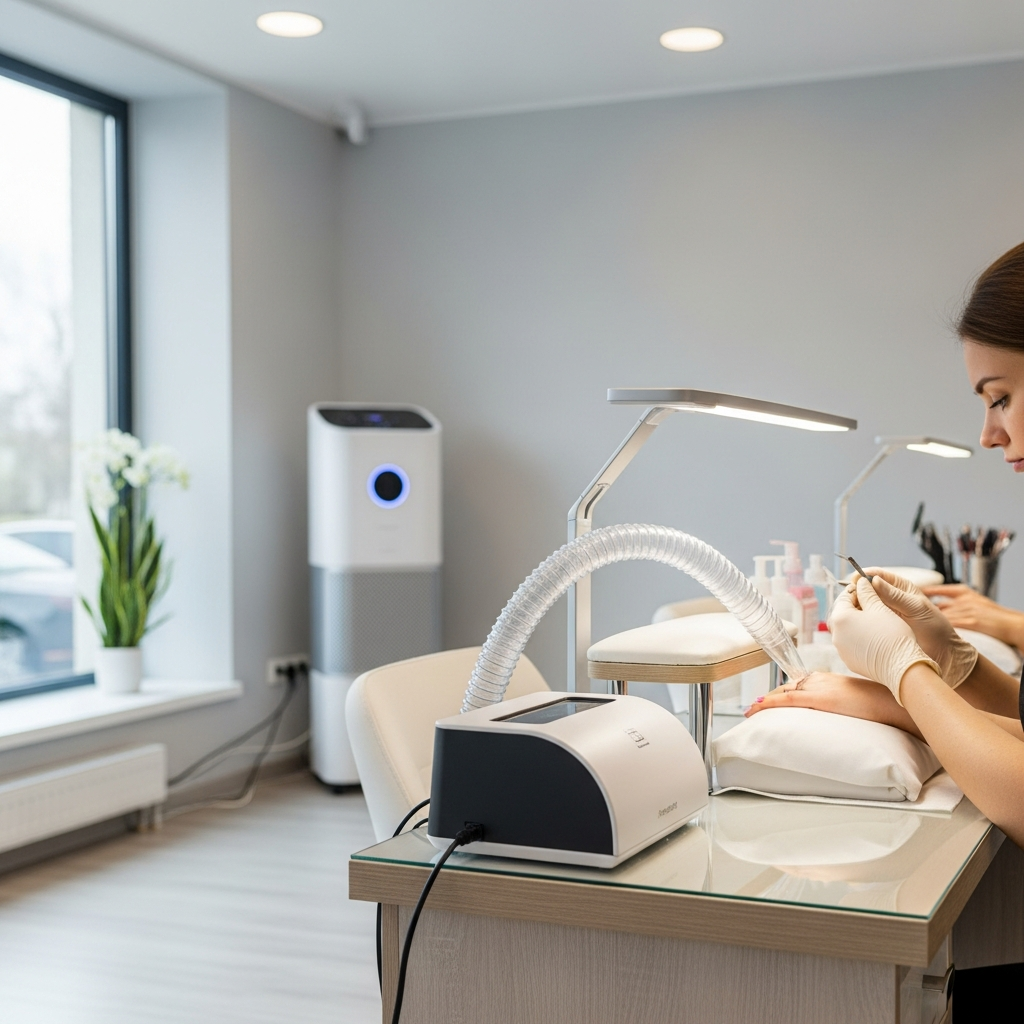
Selecting the Best Air Purification System for Your Nail Salon
Professional nail salon owners must prioritize air quality to ensure a healthy environment for staff and clients.
Chemical vapors from monomers and fine particulates from e-file services require specialized filtration systems.
Understanding the difference between various air purification technologies is essential for making an informed investment.
Source Capture Systems vs. Ambient Room Purifiers
Source capture systems are designed to extract nail dust and chemical odors directly at the manicure table.
These units use flexible ducting to pull contaminated air away from the technician’s breathing zone before it disperses.
This is the most effective method for controlling exposure to acrylic monomer vapors and cyanoacrylate adhesives.
Ambient room purifiers focus on cleaning the air throughout the entire salon space rather than at a specific station.
While these units improve general air quality, they often allow nail dust and odors to travel across the room first.
Many salon owners find that a combination of both systems provides the most comprehensive protection for their business.
Evaluating Carbon Filtration for Chemical Odor Control
Standard HEPA filters are effective for trapping nail dust but cannot neutralize volatile organic compounds (VOCs).
Nail salon owners must look for systems equipped with heavy-duty activated carbon filters to manage chemical smells.
The volume of carbon in the filter directly impacts how effectively it can absorb professional nail product odors.
When comparing models, check the weight of the carbon canister and the frequency of recommended filter changes.
Low-grade carbon filters saturate quickly in high-volume nail salons, leading to decreased performance and higher long-term costs.
Premium systems designed for the nail industry often feature refillable or extra-thick carbon stages for maximum efficiency.
Particle Filtration and E-File Dust Management
Filing dust from gel enhancements and acrylics creates microscopic particles that can linger in the air for hours.
A high-efficiency particulate air (HEPA) filter is mandatory for capturing these fine dust particles during nail services.
Ensure the purification system is rated to capture at least 99.97% of particles as small as 0.3 microns.
Evaluate the airflow capacity, often measured in Cubic Feet per Minute (CFM), to ensure the unit matches your salon size.
A system with insufficient CFM will fail to cycle the air frequently enough to keep the salon environment clean.
For nail technicians, a source capture unit with a high-velocity intake is crucial for managing heavy filing debris.
Operational Considerations for Salon Owners
- Noise Levels: Select a system that operates quietly to maintain a professional and relaxing salon atmosphere.
- Filter Replacement Costs: Calculate the annual expense of replacement filters to determine the true cost of ownership.
- Footprint and Portability: Consider whether you need a built-in table system or a portable unit that can move between stations.
- State Board Compliance: Ensure your chosen ventilation solution meets local safety regulations and professional nail industry standards.
The ROI of High-Quality Nail Salon Ventilation
Investing in professional-grade air purification reduces the health risks associated with long-term exposure to nail chemicals.
Technicians working in clean air environments report fewer headaches and respiratory issues, leading to higher staff retention.
Furthermore, a salon free of heavy chemical odors provides a premium experience that attracts and retains high-end clients.
Compare the technical specifications and filtration stages of each unit before finalizing your purchase decision.
Prioritizing systems specifically engineered for the nail industry ensures the equipment can handle the unique challenges of nail dust and vapors.
Proper ventilation is not just a safety requirement; it is a hallmark of a professional, high-standard nail salon operation.
