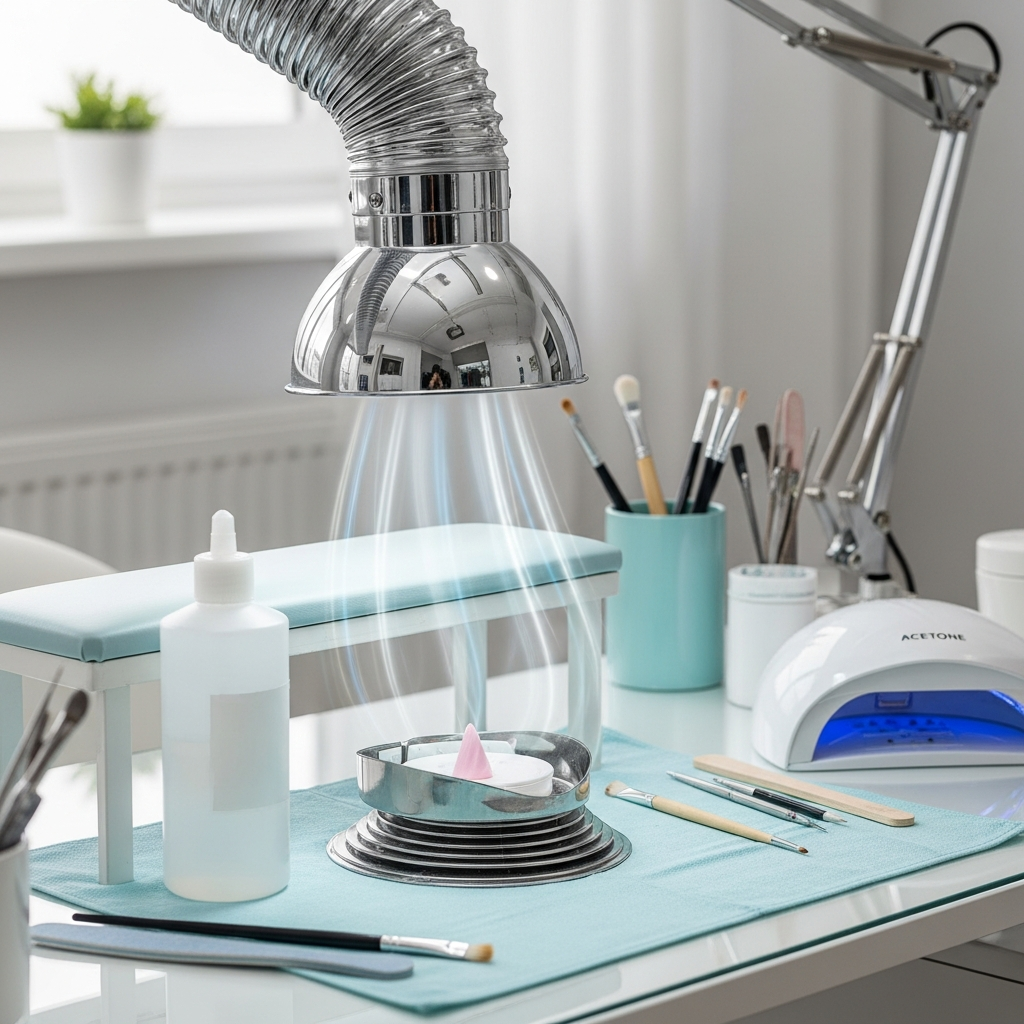
Implementing Source Capture Systems for Nail Chemical Odor Control
Managing chemical odors is a critical operational requirement for every professional nail salon owner.
The presence of volatile organic compounds (VOCs) from acrylic monomers, cyanoacrylate adhesives, and acetone impacts both air quality and salon reputation.
Effective odor control requires more than just masking scents with fragrances or candles.
It necessitates a professional-grade approach to capturing vapors at the point of origin before they migrate throughout the facility.
Understanding Nail Vapors vs. Nail Dust
In a professional nail environment, air contaminants are categorized into two distinct groups: particulates and vapors.
Nail dust is produced during the filing of acrylic, gel, or natural nails and can be managed with standard dust collectors.
Chemical vapors, specifically from Ethyl Methacrylate (EMA) monomer, require molecular-level filtration.
While dust filters trap solid debris, they cannot stop the gaseous molecules that cause the distinct “nail salon smell.”
The Role of Activated Carbon in Monomer Control
To neutralize the sharp scent of acrylic liquids, salon owners must utilize high-capacity activated carbon filters.
These filters use a process called adsorption to trap monomer molecules within the pores of the carbon media.
Professional nail ventilation systems should contain several pounds of activated carbon to be effective.
This specialized filtration ensures that the air exhausted back into the salon is free from chemical irritants and heavy odors.
Source Capture Ventilation Systems
The industry standard for chemical odor control is the source capture system, which utilizes flexible ducts positioned at the nail table.
These systems pull vapors directly away from the technician’s and client’s breathing zones during the application process.
By capturing EMA vapors the moment they leave the dappen dish, the system prevents the chemical from lingering in the room.
This localized extraction is the most efficient way to maintain a professional, low-odor environment in high-volume salons.
- Positioning: Place the extraction hood within 3 to 6 inches of the dappen dish and the client’s hands.
- Airflow: Ensure the system provides a minimum of 50 cubic feet per minute (CFM) at the point of capture.
- Maintenance: Replace carbon filters every 4 to 6 months depending on the volume of acrylic services performed.
Operational Best Practices for Chemical Management
In addition to mechanical ventilation, salon owners must enforce strict chemical handling protocols among staff.
Reducing the surface area of exposed liquids is the simplest way to decrease the rate of evaporation and subsequent odor.
Professional Dappen Dish and Waste Protocols
Technicians should always use small-bore dappen dishes with tight-fitting lids to minimize the amount of liquid exposed to the air.
Never leave open containers of monomer or acetone on the nail station when not actively in use during a service.
Used nail wipes and table towels saturated with monomer should be disposed of in a metal bin with a self-closing, foot-actuated lid.
This practice prevents vapors from escaping into the salon environment from the trash receptacle throughout the workday.
Selecting the Right Ventilation for Your Nail Salon
When investing in odor control solutions, salon owners must evaluate the specific needs of their service menu.
Salons specializing in liquid and powder (acrylic) systems require more robust carbon filtration than those focusing exclusively on hard gels.
Ensure that any air purification system chosen is specifically designed for the nail industry.
Generic room air purifiers are often insufficient for the heavy molecular weight of professional nail chemicals and will fail to provide adequate odor relief.
A clean-smelling salon is a hallmark of professional excellence and safety compliance.
By combining source capture technology with disciplined chemical handling, owners can provide a superior environment for both staff and clientele.
