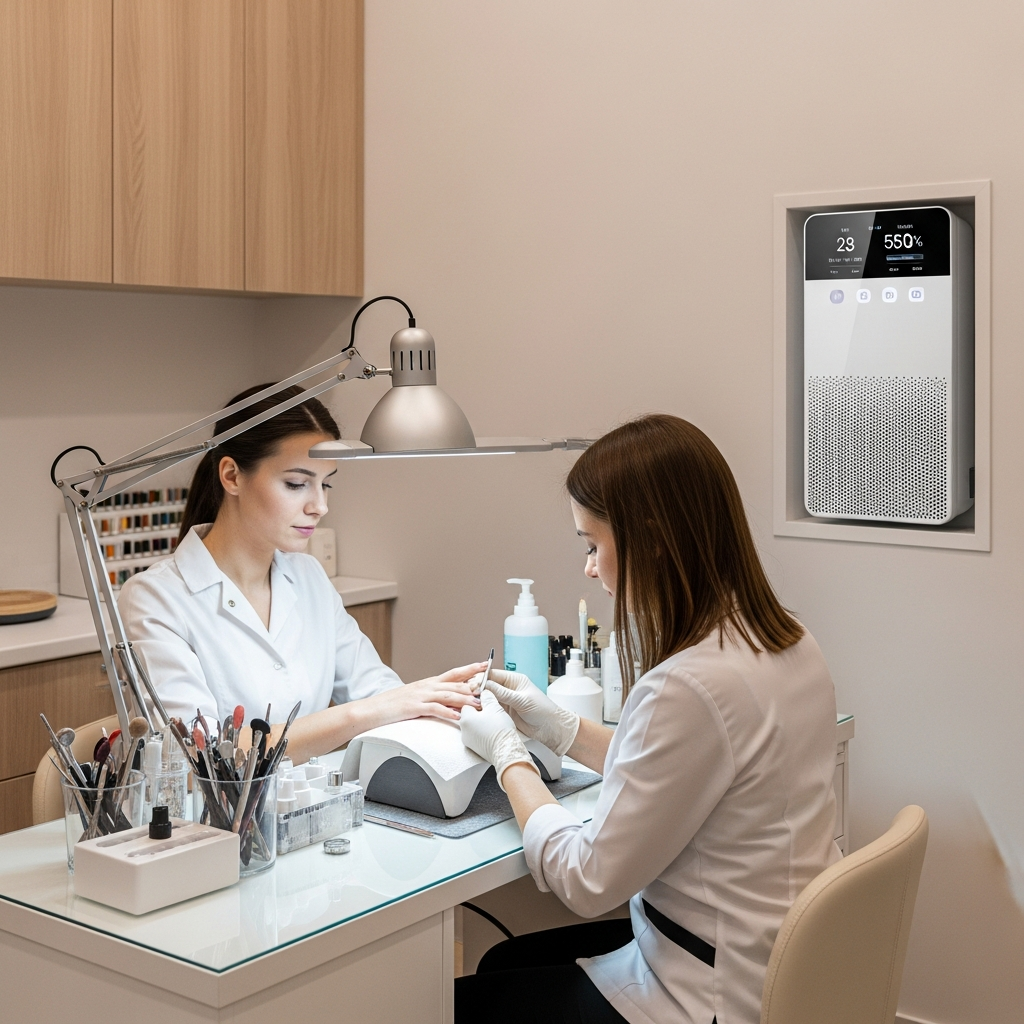
Professional Nail Salon Ventilation and Chemical Odor Control
Managing air quality is a critical operational standard for every modern nail salon owner.
Professional nail services involve volatile organic compounds (VOCs) and fine particulate matter.
Effective ventilation systems ensure a safe working environment and professional client experience.
Managing Monomer Odors and Nail Dust Particulates
Liquid monomer, specifically Ethyl Methacrylate (EMA), releases distinct chemical vapors during application.
Without proper extraction, these heavy vapors settle in the breathing zone of the nail technician.
Continuous exposure can lead to respiratory sensitization and long-term health complications for staff.
Fine dust from e-filing acrylic or gel enhancements creates a different set of air quality risks.
These micro-particles remain suspended in the air long after the service is completed.
Professional nail salons must implement dual-action filtration to address both dust and chemical vapors.
Source Capture Systems vs. Ambient Air Filtration
Source capture systems are the gold standard for high-volume nail salons.
These units extract chemical fumes and filing dust directly at the nail table before they disperse.
Effective capture requires a high-velocity suction arm positioned within six inches of the workspace.
Ambient air purifiers serve as a secondary line of defense for the general salon environment.
While source capture removes pollutants at the point of origin, ambient systems scrub the remaining air.
Combining both systems creates a comprehensive safety net for high-traffic nail businesses.
Essential HEPA and Activated Carbon Requirements
Nail salon air purifiers must utilize medical-grade HEPA filters to trap 99.97% of fine dust.
Standard filters are insufficient for the microscopic particles produced during gel removal or acrylic shaping.
HEPA filtration prevents the recirculation of nail debris into the technician’s respiratory system.
- Activated Carbon: Essential for neutralizing EMA odors and chemical VOCs.
- Filter Depth: Professional systems require deep carbon beds for maximum chemical absorption.
- Pre-filters: Protect primary filters from heavy dust to extend the lifespan of the system.
Nail Salon HVAC Standards and Compliance
Local building codes often dictate specific air exchange rates for professional nail salons.
The International Mechanical Code (IMC) requires a minimum exhaust rate for each nail station.
Owners must ensure their HVAC systems are not simply recirculating contaminated chemical air.
Proper ventilation requires a dedicated exhaust system that vents directly to the building exterior.
Relying on open doors or standard air conditioning leads to poor chemical management and higher utility costs.
Investing in a compliant ventilation setup increases the long-term valuation of the nail salon business.
Daily Maintenance Workflows for Clean Air
Source capture units require consistent maintenance to remain effective during busy nail shifts.
Technicians should clear debris from the intake grilles after every acrylic or gel service.
Full filter inspections should be documented weekly to ensure peak extraction performance.
Clogged filters significantly reduce suction power and increase motor strain on expensive equipment.
Replacing pre-filters regularly prevents the main carbon filter from becoming saturated with dust.
Clean air systems are a direct investment in the longevity and productivity of the nail technical team.
