Evaluating Air Purification Systems for Professional Nail Salons
Managing indoor air quality is a critical operational priority for every nail salon owner. Choosing between source capture systems and ambient air purifiers determines the long-term health of your technicians and the comfort of your clients.
Nail salon environments face unique respiratory challenges, specifically fine particulate nail dust and volatile organic compounds (VOCs). Standard HEPA filters alone cannot address the heavy chemical odors produced by acrylic monomers and gel systems.
Source Capture Systems vs. Ambient Air Filtration
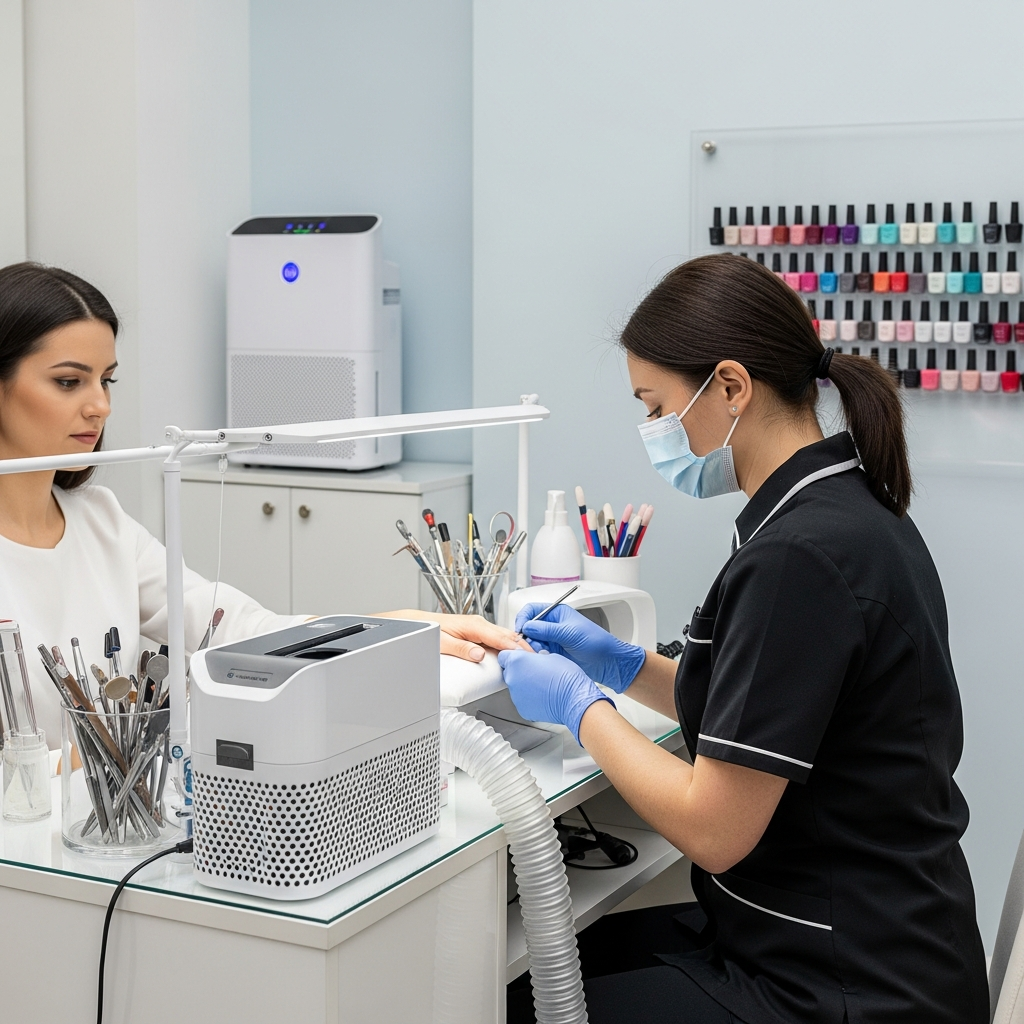
Source capture systems are designed to extract nail dust and chemical vapors directly at the manicuring table. These units use flexible ducts or ventilated desks to pull contaminants away from the technician’s breathing zone before they disperse.
Ambient air purifiers focus on cleaning the air throughout the entire salon. While these units are effective at reducing general odors, they do not prevent the immediate inhalation of filings or monomer vapors during active nail services.
Key Features of Source Capture Units
- Direct Extraction: Removes nail dust at the point of filing.
- Vapor Control: High-grade activated carbon filters neutralize monomer odors instantly.
- Regulatory Compliance: Meets many state board requirements for local exhaust ventilation in nail salons.
Key Features of Ambient Room Purifiers
- General Circulation: Filters the entire volume of air in the nail salon several times per hour.
- Particle Reduction: HEPA filtration captures microscopic nail dust that escapes the desk area.
- Client Comfort: Reduces the lingering “salon smell” in waiting and reception areas.
Technical Specifications for Nail Salon Owners
When evaluating systems, salon owners must look at the Cubic Feet per Minute (CFM) rating. A source capture system needs sufficient suction to overcome cross-drafts from salon fans or open doors during a nail enhancement service.
The depth of the activated carbon bed is equally important. For professional nail applications, a thin carbon-dusted pre-filter is insufficient. Look for systems with several pounds of pelletized carbon to handle heavy EMA (Ethyl Methacrylate) vapors.
Maintenance and Operational Costs
Maintaining air purification systems is essential for salon safety. HEPA filters must be replaced regularly to prevent nail dust from clogging the motor, while carbon filters require monitoring to ensure chemical saturation has not occurred.
Owners should evaluate the cost of replacement filters and the ease of access. Systems that require proprietary filters may have higher long-term costs but often provide better performance tailored to specific nail chemical profiles.
Checklist for Selecting a Nail Salon Air System
- Identify if the system targets both nail dust and chemical vapors.
- Verify the noise level to ensure it does not disrupt nail consultations.
- Check for compliance with the International Mechanical Code (IMC) for nail salons.
- Evaluate the footprint of the unit to ensure it fits within the nail station workflow.
Investing in high-quality air purification is not just a safety measure; it is a business strategy. A clean, odor-free nail salon attracts high-end clientele and reduces technician turnover by providing a professional, healthy work environment.
