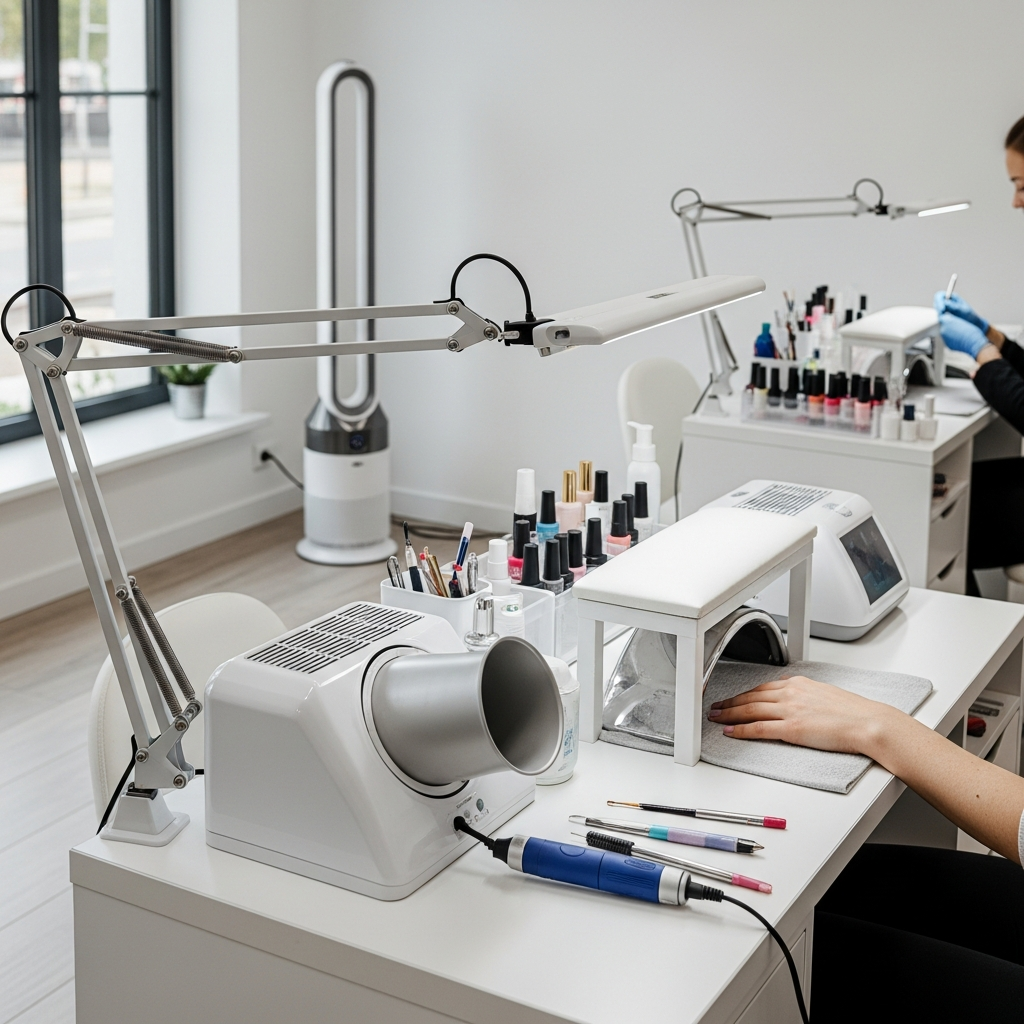
Comparing Air Purification Systems for Professional Nail Salons
Selecting the right air purification system is a critical investment for nail salon owners.
Effective systems protect the health of technicians and provide a premium experience for clients.
In a nail salon environment, air quality is compromised by fine nail dust and volatile organic compounds.
Professional nail salon air management requires a two-pronged approach.
You must address both particulate matter from filing and chemical vapors from monomer or gel products.
This guide evaluates the most effective technologies for the modern nail industry.
Evaluating Source Capture Systems vs. Ambient Air Filtration
Source capture systems are designed to remove contaminants at the point of origin.
These units feature flexible arms or integrated desk vents that pull nail dust away from the breathing zone.
They are highly effective during acrylic application and e-file removals.
Ambient air purifiers focus on cleaning the entire room’s air volume.
While they help reduce overall odors, they cannot prevent technicians from inhaling dust during a service.
For maximum safety, salon owners should prioritize source capture systems as their primary defense.
The Importance of HEPA Filtration for Fine Nail Dust
Fine nail dust particles, often categorized as PM 2.5, can remain suspended in the air for hours.
High-Efficiency Particulate Air (HEPA) filters are essential for trapping these microscopic particles.
Ensure your system uses H13 medical-grade HEPA filters for the highest capture rate.
Standard filters often fail to capture the smallest dust particles generated by high-speed e-files.
Investing in true HEPA technology reduces the “dust layer” that often settles on salon furniture.
Clean workstations improve the professional image of your nail salon and reduce cleaning labor.
Activated Carbon for Chemical Vapor and Odor Mitigation
Nail salon odors are primarily caused by Ethyl Methacrylate (EMA) and other chemical solvents.
HEPA filters cannot trap these vapors; only thick beds of activated carbon can absorb chemical odors.
Look for systems with several pounds of activated carbon to ensure long-term effectiveness.
Compare the weight of the carbon canister when evaluating different brands.
A higher carbon volume means the system can neutralize more monomer vapors before needing a replacement.
This is essential for maintaining a fresh-smelling salon that appeals to high-end clientele.
Key Operational Factors for Nail Salon Owners
- Noise Levels: Choose systems that operate quietly to maintain a relaxing atmosphere.
- Filter Replacement Costs: Calculate the annual cost of HEPA and carbon filter maintenance.
- CFM Ratings: Ensure the Cubic Feet per Minute (CFM) matches the size of your nail stations.
- Portability: Consider if you need a stationary unit or a mobile system for multiple desks.
Proper ventilation is not just about comfort; it is about long-term business sustainability.
Reducing chemical exposure lowers the risk of occupational health issues for your staff.
A clean, odor-free nail salon increases client retention and supports premium service pricing.
Consult with nail industry ventilation experts to ensure compliance with local building codes.
Always choose systems specifically engineered for nail salon chemicals rather than general air purifiers.
High-quality air filtration is a hallmark of a professional, safety-conscious nail salon owner.
