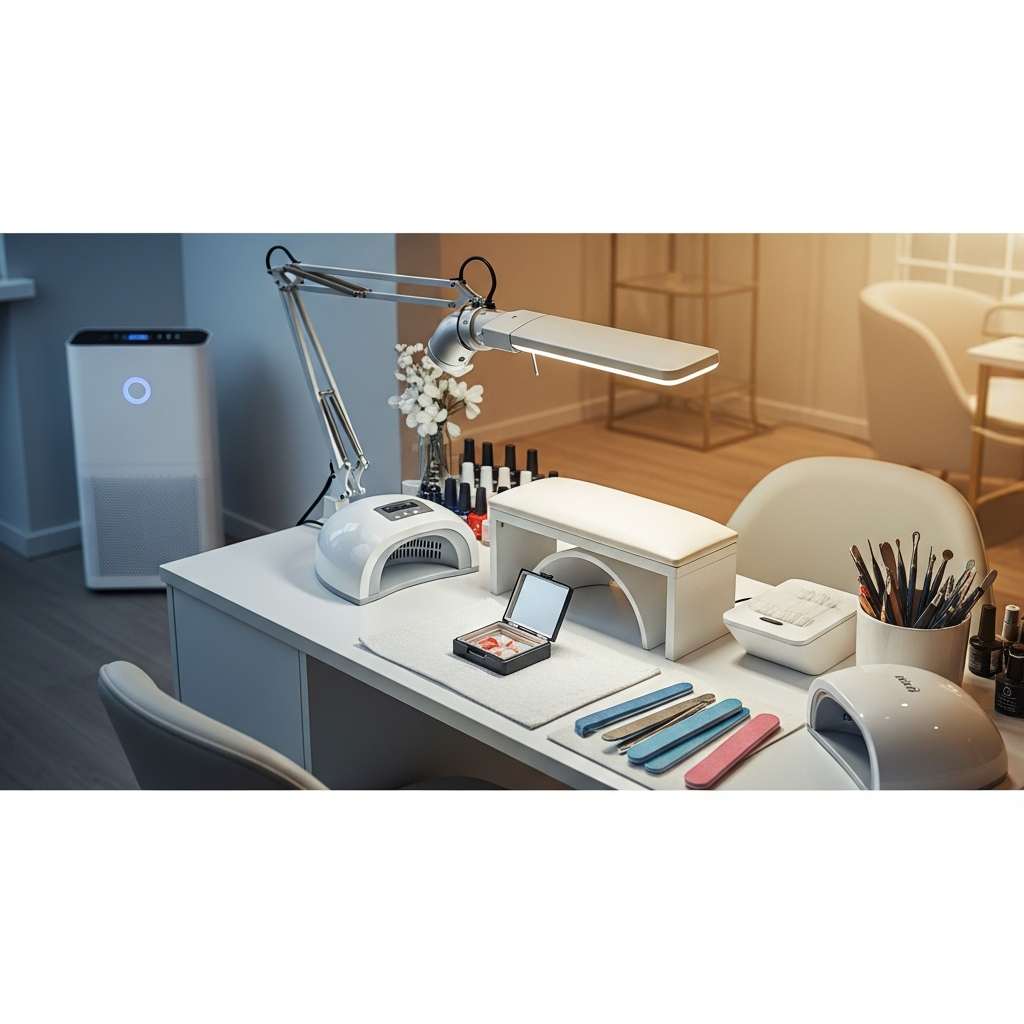
Choosing the Best Air Purification System for Your Nail Salon
Maintaining high air quality is a critical operational standard for modern nail salon owners.
Managing chemical vapors from monomer and cyanoacrylate, along with fine particulate dust from e-filing, requires specialized equipment.
This guide evaluates the two primary air purification technologies used in the nail industry.
We compare source capture systems and ambient air filtration to help you make an informed investment for your facility.
Understanding Nail Industry Air Contaminants
Nail professionals are exposed to two distinct types of airborne hazards during daily services.
The first is particulate matter, primarily fine keratin and enhancement dust generated during filing and shaping.
The second hazard involves Volatile Organic Compounds (VOCs) and chemical vapors.
These are emitted by liquid monomers (EMA), gel polishes, adhesives, and various solvents used in nail applications.
A standard residential air purifier is insufficient for these specific nail industry bypasses.
Professional systems must feature both HEPA filtration for dust and heavy-duty activated carbon for chemical odors.
Source Capture Systems: Professional Bench-Top Solutions
Source capture systems are designed to extract contaminants directly at the nail technician’s breathing zone.
These units typically feature an adjustable intake arm or a built-in desk vent near the client’s hand.
Advantages of Source Capture in Nail Salons:
- Captures e-file dust before it settles on salon surfaces or professional tools.
- Significantly reduces the inhalation of monomer vapors by the technician and client.
- Prevents the migration of chemical odors into the waiting area or neighboring businesses.
When evaluating these units, look for high-velocity suction and multi-stage filtration.
Ensure the carbon filter is thick enough to adsorb heavy concentrations of nail enhancement vapors.
Ambient Air Filtration: Managing Total Salon Environment
Ambient systems focus on cleaning the “room air” rather than capturing dust at the workstation.
These are often ceiling-mounted or floor-standing units that cycle the entire volume of air in the salon.
While effective for general air quality, they do not stop dust from settling on your nail tables.
They serve best as a secondary layer of protection alongside source capture ventilation.
Key Specifications for Nail Salon Owners
Before purchasing, salon owners must evaluate the Clean Air Delivery Rate (CADR) for the salon’s square footage.
A professional nail salon requires a higher air exchange rate than a standard retail environment.
Check the cost and frequency of filter replacements for each system.
High-volume nail salons may need to replace pre-filters weekly to maintain optimal suction and motor life.
Evaluation Checklist for Salon Ventilation Investment
Use the following criteria when comparing professional air purification brands:
- Filter Composition: Does it include a medical-grade HEPA filter and at least 3lbs of activated carbon?
- Noise Levels: Will the unit interfere with technician-client communication during nail services?
- Portability: Can the unit be moved between nail stations or is it a fixed installation?
- Maintenance: Are filters easily accessible for staff to change without specialized tools?
Investing in the right system ensures compliance with safety standards and improves staff retention.
A clean, odor-free environment is a hallmark of a premium, professional nail salon operation.
