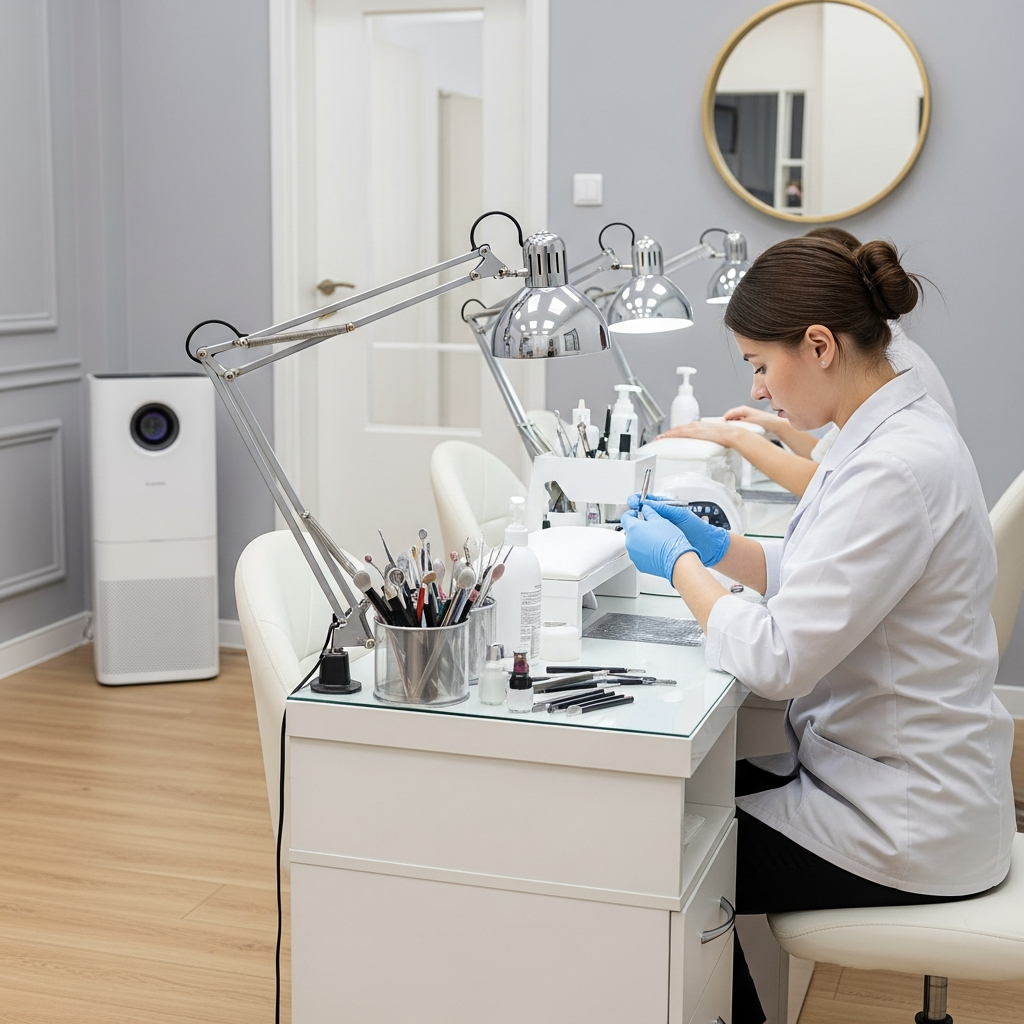
Evaluating Air Purification Systems for Professional Nail Salons
For nail salon owners, managing indoor air quality is a regulatory necessity and a staff retention strategy. High-performance air purification is essential to mitigate the risks associated with volatile organic compounds (VOCs).
Standard air cleaners used in residential settings are insufficient for the heavy chemical load of a professional nail environment. Owners must evaluate systems specifically designed to handle cyanoacrylates and monomer odors.
Selecting the right system requires understanding the difference between ambient room filtration and source capture technology. This guide helps you compare professional solutions to ensure a compliant and healthy nail salon.
Evaluating Source Capture vs. Room Air Filtration
Source capture systems are the gold standard in the nail industry. These units feature flexible arms placed directly at the nail table to vacuum dust and vapors before they reach the technician’s breathing zone.
Ambient room purifiers circulate the air throughout the entire salon. While these are excellent for general air freshness, they allow nail chemicals to travel across the room before they are filtered out by the system.
A dual-system approach is often the most effective for high-volume nail salons. Using source capture for acrylic services and room-wide filtration for general maintenance ensures maximum protection for both staff and clients.
Key Components: Activated Carbon and HEPA Filters
When comparing units, look at the weight of the activated carbon filter. For nail salons, a thick carbon bed is required to chemically adsorb heavy odors from EMA monomers and gel polish removers.
HEPA filtration is equally vital for capturing microscopic nail dust produced during e-file services. These particles can remain suspended in the air for hours if not properly trapped by a medical-grade HEPA filter.
Ensure the system you choose lists the “Clean Air Delivery Rate” (CADR) specifically for chemicals. Many standard purifiers only rate for dust and pollen, which does not reflect the needs of a nail professional.
Operational ROI: Filter Life and Energy Efficiency
Evaluating the long-term cost of a nail air system involves checking the frequency of filter replacements. Systems with pre-filters help extend the life of expensive HEPA and carbon cores by catching large debris first.
Energy-efficient motors are a priority for salon owners running systems ten hours a day. Look for brushless motors that provide high CFM (Cubic Feet per Minute) airflow while maintaining low noise levels for a quiet environment.
Consider the footprint of the unit within your nail salon layout. Portable units with wheels offer flexibility, while built-in vented desks provide a seamless aesthetic but require permanent installation and ductwork.
Selection Checklist for Nail Salon Owners
- Verify the system is specifically rated for nail salon VOCs and monomers.
- Check if the source capture arm is adjustable for different nail service heights.
- Compare the cost of annual filter replacements across different brands.
- Assess the noise level (decibels) to ensure it doesn’t disrupt nail consultations.
- Confirm the unit meets local ventilation codes and safety standards.
Investing in a high-grade air purification system reduces the accumulation of nail dust on salon surfaces. This leads to a cleaner facility, lower maintenance costs, and a professional reputation for safety excellence.
